



Norway is wonderful for a road trip, as long as you know a few rules and local habits before you set off. Here are the essentials, whether you drive your own car or a rental car.
A few driving rules
Dipped headlights are compulsory at all times, day and night and all year round. Speed limits are low and strictly enforced, with frequent speed cameras and high fines.
The legal blood alcohol limit is 0.02% (0.2‰). The simplest is not to drink at all before driving. Seat belts are compulsory for all occupants, and using a hand-held phone is prohibited.
On the road, keep your eyes open. Moose, reindeer and sheep can cross without warning, especially at dawn and dusk. If you hit an animal, you must notify the police, even if you are not injured.
Give way to the right
In Norway, the general rule is to give way to the right: at a junction with no other signage, you must yield to vehicles coming from your right. This principle surprises many visitors from the UK, the USA or other countries where it does not exist, and it is a common cause of hesitation at junctions.
To indicate that a road has priority, Norway uses the yellow diamond sign with a white border. As long as it is visible, you are on the priority road and vehicles coming from side streets must give way to you. When the same diamond appears crossed out with a grey bar, your priority ends: the give-way-to-the-right rule applies again. When in doubt, especially in residential areas, always assume a vehicle may appear from your right.
Behaviour on the road
Driving is generally calm and courteous. Most drivers stick carefully to the speed limits. Use your indicator when leaving a roundabout and slow down as soon as a pedestrian seems about to cross.
On narrow roads, use the passing places to let oncoming vehicles through. If a queue forms behind you, use a safe spot to let local drivers past. Never stop in the carriageway to take a photo.
Speed and enforcement
Speed limits are everywhere and always clearly signed. Here are the standard values to know before you set off.
| Area | Limit |
|---|---|
| Built-up area (town, village) | 50 km/h |
| Outside built-up areas | 80 km/h |
| Motorway | 110 km/h |
In addition, residential zones are often 30 km/h, and some roads show 60, 70, 90 or 100 km/h depending on the stretch. 110 km/h is the maximum permitted speed in Norway.
As for enforcement, fixed speed cameras (the “fotoboks”) are always announced in advance by a sign: no trap. Mobile patrols, however, are not announced and can set up anywhere; in practice they leave the road in the evening, after 9 pm. Remember that the lower the limit, the more a small amount of speeding costs you, and that is often where checks are concentrated.
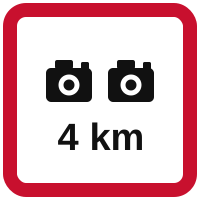
Finally, a few stretches use average speed control (“strekningsmåling”): your average speed is measured between two points, over the whole length of a segment. It is announced well ahead, by a sign showing two speed-camera pictograms and the length of the segment in kilometres.
Do not underestimate journey times
Do not rely on the number of kilometres alone. Speed limits, winding roads, ferry crossings and stops make journeys noticeably longer than they look on a map.
Avoid planning several hundred kilometres each day if you want to enjoy the trip. Also add a margin when your route includes a ferry or a mountain pass.
Driving in winter and in the mountains
In winter, a rental car is normally fitted with suitable tyres, with studded tyres in the north. If you come with your own vehicle, make sure you have compliant winter tyres. Either way, that does not guarantee that all roads are passable: passes can close because of snow, wind or ice, sometimes even in spring or autumn while conditions seem good down in the valley.
Check the weather and road conditions before every long drive. The website and app of Statens vegvesen provide real-time information on closures, passes, tunnels and ferries.
In case of a breakdown or accident
In case of a breakdown, bring the car to a safe stop, switch on the hazard lights, put on the reflective vest and set out the warning triangle if conditions allow. With a rental car, first contact the assistance shown in the contract or app. Do not arrange a tow yourself without the rental company's agreement, as the costs might not be reimbursed.
In case of an accident, photograph the scene and the damage, take down the details of those involved and, with a rental car, inform the agency immediately. Call 112 if urgent help is needed and 02800 to reach the police in a non-urgent situation. The national road traffic information centre can also be reached on 175 from Norway or +47 22 175 175 from a foreign number.
In brief
- Give way to the right at junctions with no signage; the yellow diamond marks a priority road.
- Dipped headlights on at all times; alcohol limit at 0.02% (0.2‰).
- Calm driving: indicate when leaving a roundabout, give way to pedestrians.
- Narrow roads: use the passing places, never stop in the carriageway.
- Winter and mountains: check the weather and road conditions (Statens vegvesen); passes can close.
- Journey times: allow plenty (low speed, bends, ferries).
- Breakdown: secure the car, hazards, vest and triangle; rental company's assistance if a rental.
- Emergency: 112; non-urgent police: 02800; road information: 175.